

How I Live Now
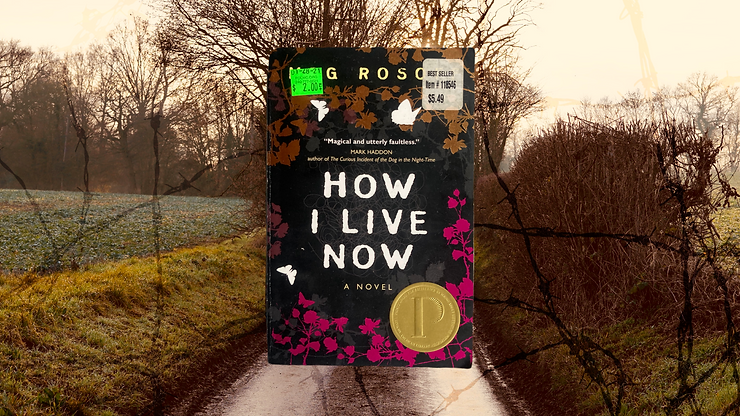
I found How I live now at the Friends of the Montgomery County Library bookstore. I was searching for Powers by Ursula K. Le Guin because Indiebound said it would be there. I didn’t find it, but I did find this one, which I bought for two dollars. It was shelved in the fiction section, not the YA section.
I loved this book. I read it in like 2 days. I know it’s less than 200 pages, so it isn’t that much of a brag, but please take this as proof that this book was interesting and electrifying from the beginning. The narrator is a 15 year old American girl named Daisy, who moves from New York to live with her cousins in England. While there, a series of attacks by an unnamed Enemy leads to an Occupation of England. Food, power and healthcare systems breakdown as the cousins try to reorder their lives to this new reality.
For once, I’m not gonna spoil the plot in my reviews. Instead, I will hit the highlights of this book. The first bit that stands out is the voice. As I mentioned, the narrator is a 15 year old New Yorker now living in England. And shit, she sounds like a 15 year old. Simultaneously defiant, confident, insecure, hostile and desperate for love, Daisy’s perceptions (and therefore the book itself) is clearly colored by her opinions. She may dismiss what an adult might examine, and focus on what adults might deride, but none of her thoughts feel over dramatic- everything is Exactly as Important as she believes it is.
Which brings me to my next favorite part of Rosoff's writing: Capitalization For Emphasis. I already do this when writing casually (usually texting), but always feel like I can’t do it on here because it’s not proper grammar. Seeing this style of writing in a fully published book is Extremely Validating for the way I prefer to write, sort of fast and loose with the grammar. In fact, this is how Rosoff writes to develop 15 year-old Daisy’s voice. (Does this mean I write like a 15 year old? Who’s to say.) There’s no quotations in the dialogue, only “he was like…”, and a lot of run-on sentences which I absolutely adore even though sometimes reading it feels like you’re sprinting downhill and you won’t stop until you’re crashing into the period. Then before you know it you’re hurtling into the next sentence and you have no idea where it will end but you just want to know what will happen next and what Daisy will think about it so you keep going. I can see why Rosoff wrote this way, it’s fun to read and fun to write and now that I’ve started writing like this I don’t want to stop, but maybe I’ll just find another book written in this style so I can write about that too.
Once again, I have to put a trigger warning on this book: there’s mentions of self-harm at the ends and there’s some incest. It’s not, like, sexual abuse, it more has to do with the general breaking down of social systems. there’s no more food distribution systems, and there’s a change in how family members love each other. The Love Laws become as meaningless as other laws in the Occupation.
Despite the incest, this is still a really good book. It’s engaging and suspenseful (without being a thriller). Daisy is endearing, and reading her narration reminds you of how it felt to be a teenager- and reminded me of how much I am not a teenager any more. It’s both thought-provoking and a quick read, which I don’t find very often.
I would recommend this book for teenagers and young adults with at least a little bit of anxiety about the state of the world.
My Copy: Rosoff, Meg. How I Live Now. New York, Wendy Lamb Books, 2004. Get it Here!
Background Photos:


Comments