

Howl's Moving Castle
Updated: Nov 1, 2021
By Diana Wynne Jones
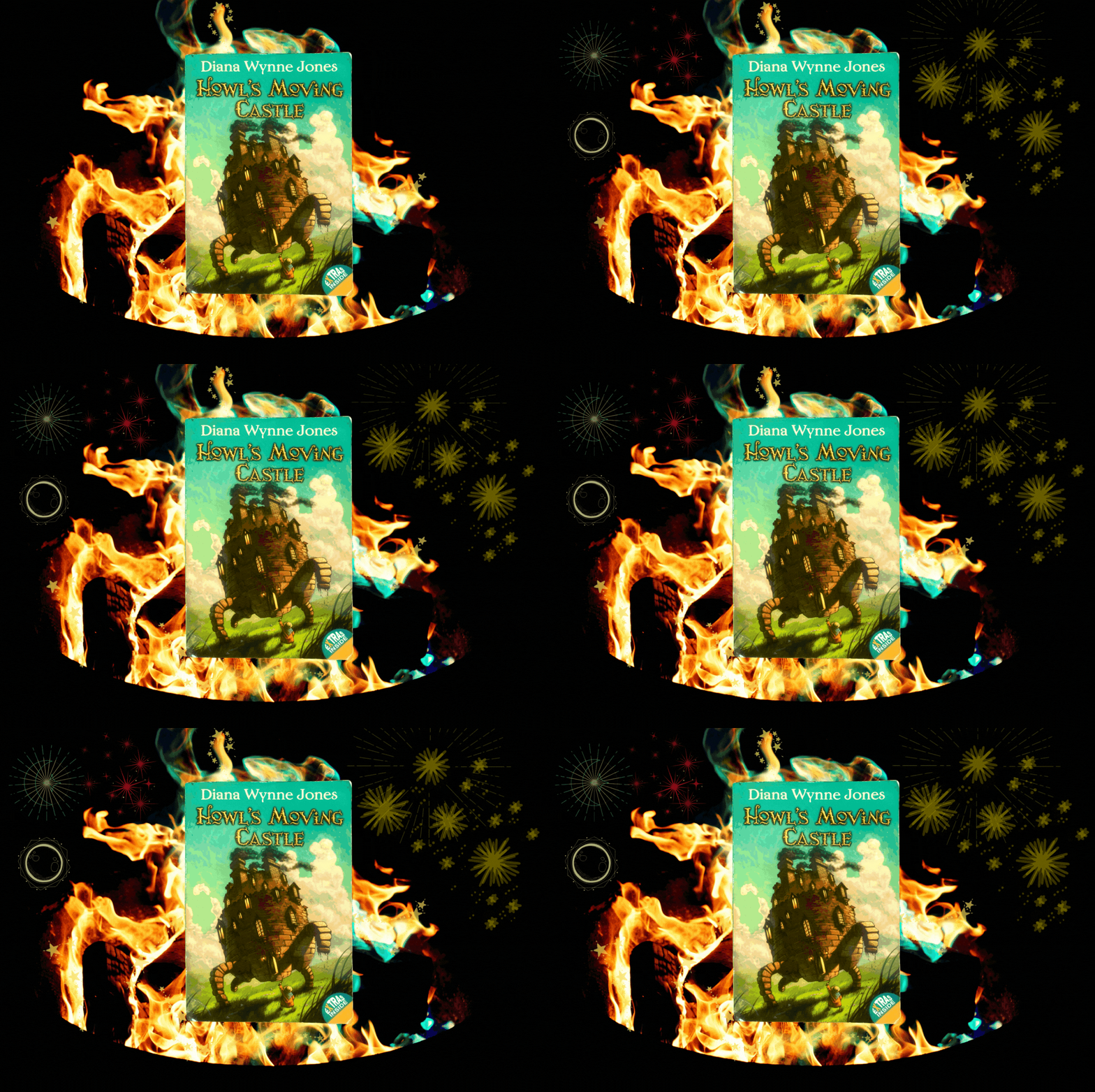
Once again, I have committed book-lovers treason and watched the movie before I read the book. Howl’s Moving Castle (the movie) is a beautifully animated film made by Studio Ghibli, and directed by Hayao Miyazaki (Spirited Away, Kiki’s Delivery Service). When I saw the movie, I didn’t even know there was a book, so when I spotted it on a store shelf, I knew I had to get it.

It was a few years ago, on a family trip to Portland, Oregon. We were either dropping off my sister at college or visiting her there, but, as with every other trip to Portland, we stopped at Powell’s City of Books (not to be confused with Powell’s, the bookstore in Hyde Park, Chicago). I read it quickly, and had finished it in time to lend to my mom for the flight back home.
Having seen the film, I figured I would already know the basic plot of the book. But this is no Pride and Prejudice, as wonderful as the film is, it cut out a lot of central sections, so that, though it starts in the same way, the ending of each is entirely different. The book surprised me, which, honestly, made it more fun to read. The ending of the book is full of twists and turns, and I’m glad I didn’t already know the outcome. Since then, I have read it many times, which every future reader of this book should do. The plot of this book is so natural that I almost didn’t expect the ending to come when it did. It wasn’t out of place, there were certainly hints along the way that make it an understandable ending, but it can be difficult to pick up on them the first time around.
Despite the name, the main character of the book is Sophie Hatter. She lives in a vaguely Edwardian fantasy country, named Ingary. The book begins with Sophie living and working in her late father’s hat shop, now run by her stepmother, living a life so small that she’s fearful of leaving the house. She’s visited one day by the Witch of the Waste, who accuses her of encroaching on her territory. She curses Sophie with old age, turning the 20 year old to a creaking woman of 70 or so. The change drives Sophie to leave, despite her reservations at being the eldest, to seek her fortune. She eventually ends up at… Howl’s Moving Castle! She then does what we all would do in a wizards castle, makes a deal with a fire demon, then immediately goes to sleep.
Sophie’s a great main character, because she screws up a lot. She tries her best, but the universe does not align to meet her needs. Sophie blames her mistakes on being “the eldest of three” and assumes she is doomed to be a failure because of it. It’s first mentioned in the opening chapter, when her step mother splits up the three girls, citing financial issues. The youngest, Martha, is expected to do the best in life, so she is sent to be a witch’s apprentice while Lettie, the second youngest, goes to be an apprentice at a local bakery. Sophie remains in the hat shop. All acquiesce to the plan, but none seem particularly satisfied with it. Yet Sophie cites their birth order to justify their fates. The actual reason for this can be found in fairy tales. Think of Cinderella or The Three Little Pigs; the youngest always “wins”. They get the prince or survive a wolf attack. The other two, selfish or foolish, face violent ends to justify their ill behavior. In this world, people are not only aware of the trope, but it is assumed to be true. Sophie believes that Martha will be successful because she is the youngest, and only because she’s the youngest, and she believes she will fail herself because she is the eldest, and for no other reason. This is a narrative that is aware of it’s fairy tale setting, and equally aware of the fairy tale tropes.
Yet it calls attention to these tropes only to subvert them. In the first few pages, the narrator explains how Sophie and Lettie are born to the same mother, while Martha is born to their stepmother. The book explains that “this ought to have made Sophie and Lettie into Ugly Sisters, but in fact the three girls grew up very pretty indeed, though Lettie was the one everyone said was most beautiful” (2). The narrator directly references Cinderella, only to explain that these girls are Not at All Like That. And they really aren’t. Sophie is separated from her sisters for most of the novel, but it’s clear that they love and care about each other. By the end of the book, the one declared “most beautiful” is the only one not in a relationship.
This fairy tale land is home to no fairy tales. The characters have read the script, but can’t seem to remember the lines. Sophie is an unlikely heroine of a fairy tale. She’s extremely reluctant to take part in any kind of story. It takes a literal curse to force her on an adventure, and she grumbles at every challenge she faces, sure that she shouldn’t be made to do it. She’s not a pretty young woman who’s so virtuous and good that she’s destined for a cosmic reward. She’s an old lady for most of the book, and she often behaves poorly. She has good intentions, but that’s not always enough. Despite her early timidity, Sophie quickly grows into a headstrong old lady. She’s extremely determined, unapologetically nosy, and really doesn’t give a fuck. She’s who I want to be when I grow up.
Howl is also an unlikely hero of the book. He’s vain, cowardly, dishonest, and has a bad habit of falling in love with women- until the moment they love him back. Most of his faults are not fixed by the end, of the book. He doesn’t really “learn his lesson”, but, just as Sophie realizes she’s not nearly as timid as she thought she was, so too is it revealed that he’s capable of bravery, honesty, and deep love.
In many ways, this book is great because it takes these tropes, then absolutely refuses to do them. And not just with the characters. Fairy tales usually follow a fairly simple plot with a specific tone and with little world building. This plot is more complex, it’s tone is often humorous or ironic, and excellent soft worldbuilding which points to forces outside the scope of the narrative.
I recommend this book to people looking for a fun read, a magical adventure, and flawed, loveable characters.
My Copy: Jones, Diana Wynne. Howl’s Moving Castle. Reprint, Greenwillow Books, 2008. Get it Here!
Banner Background: "Colorful Flames" by Chris Rhoads, 2017.
Photo: “Portland July 2017 43 (Powell's Books)” by Michael Barera, 2017. Licensed under CC BY-SA 4.0


Comments